Hannett took the guitars out of the middle
Recorded flat, then ruined on purpose
The signal went to tape clean; the decision came later — and later was where the sound was made.
Named on this page
- Martin Hannett
- Strawberry Studios
- Britannia Row
- Joy Division
- Factory Records
- Watkins Copycat
- Roland Space Echo
- dbx
- Urei

The take and the treatment
The standard rock-production instinct is to chase a sound at the source: mic position, room choice, the player’s own tone. What distinguished a significant strand of post-punk and early darkwave production was a deliberate reversal of that instinct. The track went to tape as flat and unprocessed as the room allowed, and everything that made it recognisable as a genre sound — the violence done to the drum transient, the smear on the vocal, the artefact where the reverb tail collided with the next beat — was applied afterwards, sometimes days later, as a distinct compositional act.
Martin Hannett worked this way at Strawberry Studios in Stockport and at Britannia Row in London with a consistency that amounted to a method. The basic tracks were recorded with care and with relatively little treatment; the processing session was the session that mattered. Gating was applied to drums that were already on tape, which meant the gate’s threshold and release time could be set against a known, fixed signal rather than against a live performance still in flux. The result was the characteristic hard cut — the drum hit sounding, then not sounding, with no natural room decay permitted to follow it — that appears across the Joy Division recordings and became one of the production signatures of the era. The gate was not capturing a sound; it was amputating one.
The gate was not capturing a sound. It was amputating one.
How the chain worked
- Flat trackingSignal to tape with minimal treatment, preserving transient integrity for later decisions
- Gated drum processingNoise gate applied after tracking; threshold and release set against a fixed tape signal
- Post-facto compressionHeavy ratios applied after the take; attack suppressed to reshape the sustain envelope
- Tape delay as re-compositionEcho timing and feedback chosen as an editorial act rather than a live effect
Compression and the destroyed transient

Compression applied after the fact behaves differently from compression in the signal chain during a take. When the ratio and attack time are set against tape, the engineer is hearing exactly what the compressor will hear every time; there is no variation between passes. This made heavy, deliberate compression — ratios that would be considered destructive in a live-tracking context — workable as a precise tool. A snare hit recorded flat has a fast transient followed by a decay; extreme compression after the fact can invert the perceptual balance, pushing the attack into the noise floor and swelling the body of the sound. Applied to bass guitar, the same technique produces the sustained, almost synthesised low-end that runs through a large body of early-1980s Factory Records releases: the string is plucked, the transient is crushed, and what arrives at the listener is the sustain behaving like a held note.
Tape delay adds a further layer of retrospective decision-making. A tape echo unit — the Watkins Copycat and the Roland Space Echo were the machines most commonly found in British studios of this period — introduces a delayed repeat whose timing is set by the physical speed of the tape loop and the distance between record and playback heads. Applied to a signal already committed to multitrack, the delay becomes a form of re-composition: the engineer is choosing not just a tempo-relative delay time but the degree to which the repeat bleeds into the following beat, whether the feedback accumulates into a wash or stays discrete, and how the delayed signal interacts with the reverb already sitting on another track. Done during tracking, these are guesses against a moving target. Done afterwards, they are choices.
Why the order mattered
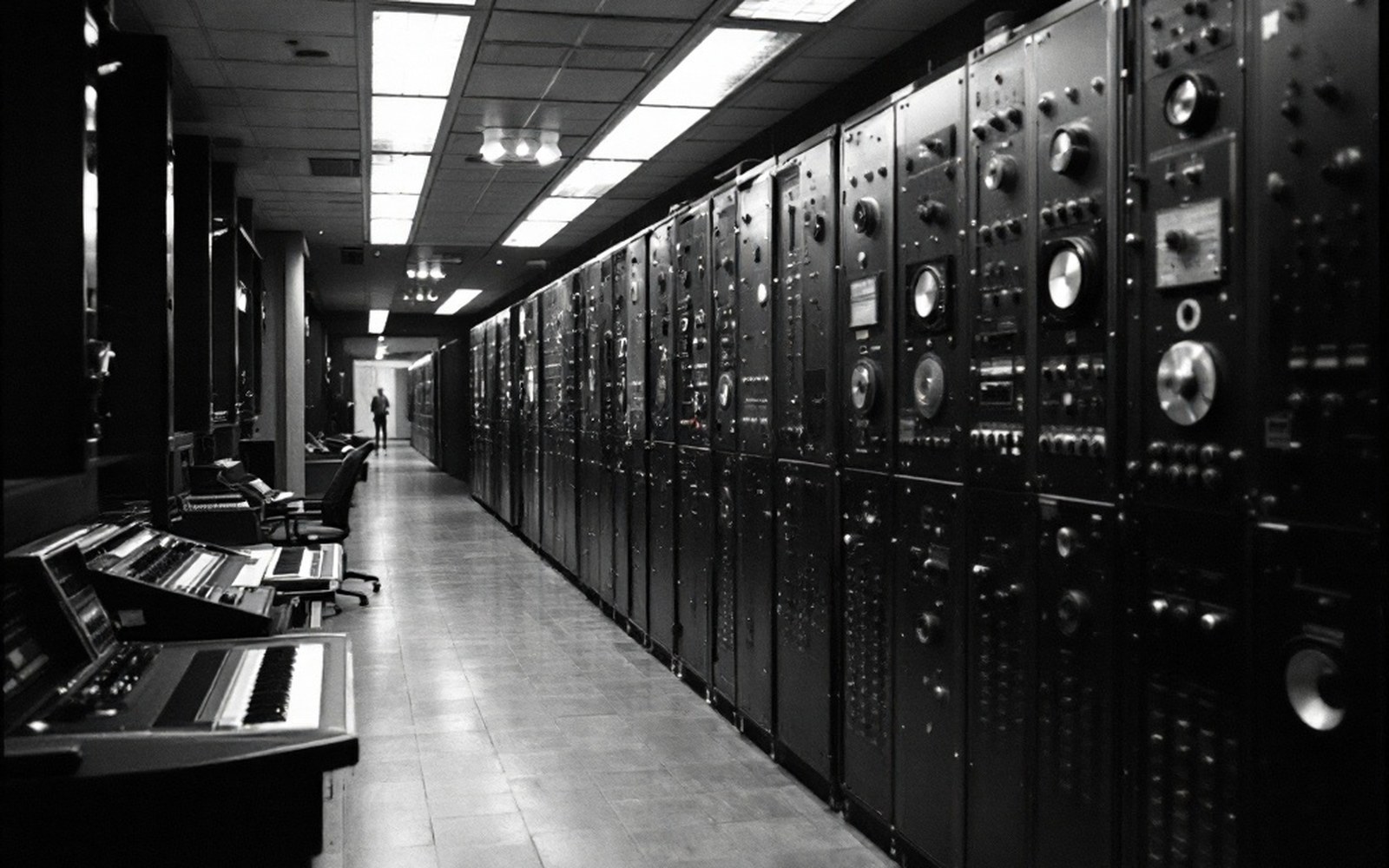
The approach was partly practical and partly philosophical. Practically, it allowed the musicians to perform without processing artefacts in their monitors affecting their feel; a drummer playing against a heavily gated reference of their own kit will compensate in ways that change the performance. Philosophically, it treated the processing as composition rather than capture — the sonic character of the record was not incidental to the take but was authored separately. This is the context in which gated reverb made its most extreme appearances: not as a happy accident of a large room and a noise gate, but as a decision made in silence, after the players had gone home, with the tape as raw material. The record that came out was not a document of a room. It was a document of what someone decided to do to what had happened in a room, and those are not the same thing.
Key machines mentioned
| Unit | What it contributed |
|---|---|
| Noise gate | Hardware cutting signal below a set threshold; used to hard-truncate drum decay |
| Tape echo | Physical loop machine — Watkins Copycat, Roland Space Echo — producing rhythmic repeats via head spacing |
| Multitrack tape | The medium that made separating the tracking and processing sessions possible at all |
Table scrolls sideways →
Related pages