Hannett took the guitars out of the middle
Hannett took the guitars out of the middle and left the space where they had been
The reverb was not decoration. The space between the instruments was the mix.
Named on this page
- Martin Hannett
- Strawberry Studios
- Arrow Studios
- Joy Division
- Factory Records
- Bernard Sumner
- Peter Hook
- Stephen Morris
- AMS DMX 15-80
- Roland CR-78
Thinning the centre
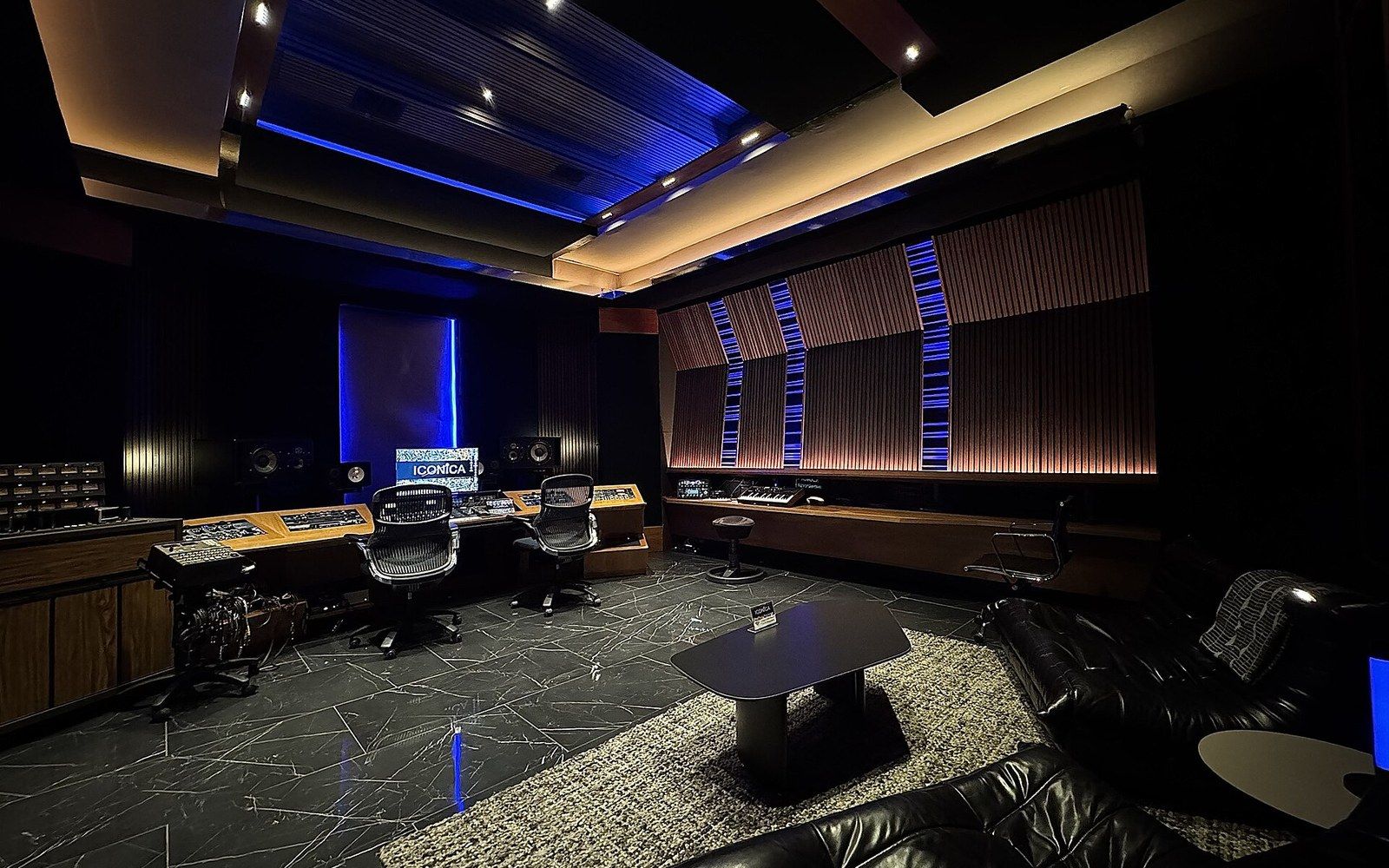
The standard move in rock production by the late 1970s was to fill the middle: rhythm guitar doubled and panned slightly, bass driving up from beneath, a vocal sitting just above it all in a bed of sound that left nowhere for the ear to rest. Martin Hannett reversed the logic. Working primarily at Strawberry Studios in Stockport and later at Arrow Studios in Manchester, he treated the centre of a stereo mix as something to be evacuated rather than packed. Guitars were pushed to the edges or pulled back in level until they occupied a frequency range where they registered as texture rather than presence. What remained in the middle was a gap — or rather, a carefully managed acoustic environment that sounded like a gap.
This was not minimalism for its own sake. Hannett was a trained sound engineer who understood what equipment actually did to signal, and his decisions were technical before they were aesthetic. He would record drums in isolation, often treating each component separately — the snare processed differently from the hi-hat, the kick treated as its own event rather than part of a kit playing together. By the time the drum tracks reached the mix, they sounded as though each drum occupied its own room, which was more or less what Hannett had arranged. The effect was percussion as architecture: it provided the structure the guitars no longer filled.
Percussion as architecture, holding up what the guitars no longer filled
The decision on Joy Division’s records
The place where this approach is most audible, and most documented, is the work Hannett produced for Joy Division, released through Factory Records between 1978 and 1980. On Unknown Pleasures (FAC 10, 1979), Bernard Sumner’s guitar parts are present in a formal sense — they are credited, they are mixed in — but they do not dominate. The tracks are built around Peter Hook’s high-registered bass lines, which occupy melodic territory that a lead guitar would normally hold, and around Stephen Morris’s drum treatments, which Hannett had run through a digital delay unit. The guitars sit behind this, colouring the edges of the sound rather than driving from the centre.
Hannett used an early AMS DMX 15-80 digital delay — a piece of hardware that was, in the late 1970s, extremely expensive and available to very few studios — to place individual elements at specific distances from the listener. The delay times he chose were not set to produce audible echo effects; they were short enough that the ear read them as spatial depth rather than repetition. A snare hit arrived and then the room arrived, in that order, and the sequence told the brain the room was large. Combine that with plate reverb on specific elements and the result was not a band playing in a studio but a reconstruction of a space that did not exist.
This matters because it shifts the question of what the music sounds like. The Joy Division records do not sound sparse because Hannett recorded few instruments. They sound sparse because he created distance between the instruments that were there, and distance reads as absence. The guitars are audible, but the space where a denser guitar arrangement would have lived is audible too, and the space is louder.
Equipment at the centre of the approach
| Machine | What it was doing in the mix |
|---|---|
| AMS DMX 15-80 | Digital delay, expensive and rare in the late 1970s; short delay times used to create spatial depth rather than echo |
| Roland CR-78 | Early programmable drum machine; a mechanical constancy a live drummer could not reproduce |
| Chorus pedal | Widened guitar parts across the stereo field without adding mid-frequency weight |
| Plate reverb | Applied to specific elements to construct a large-room acoustic that did not physically exist |
Table scrolls sideways →
What the engineer actually did
Hannett’s methods were not universally welcomed by the people he was recording. Members of Joy Division — and of other Factory-signed acts — documented in interviews that Hannett exercised a degree of control over the recordings that felt, from inside the room, like obstruction. Hannett had opinions about mic placement, about the acoustic properties of floors and stairwells, about what time of day a recording session should run. These were not eccentricities; they were the operational logic of a producer whose finished product was a spatial experience rather than a captured performance.
He made significant use of the Roland CompuRhythm CR-78, one of the earliest programmable drum machines, on sessions where the rhythmic element needed a quality that a live drummer in a room could not provide — a mechanical constancy that emphasised, rather than disguised, the clinical quality of the overall production. Where a rock producer would have asked the drummer to play more naturally, Hannett often moved toward less natural: more processed, more distant, more like a signal than a performance.
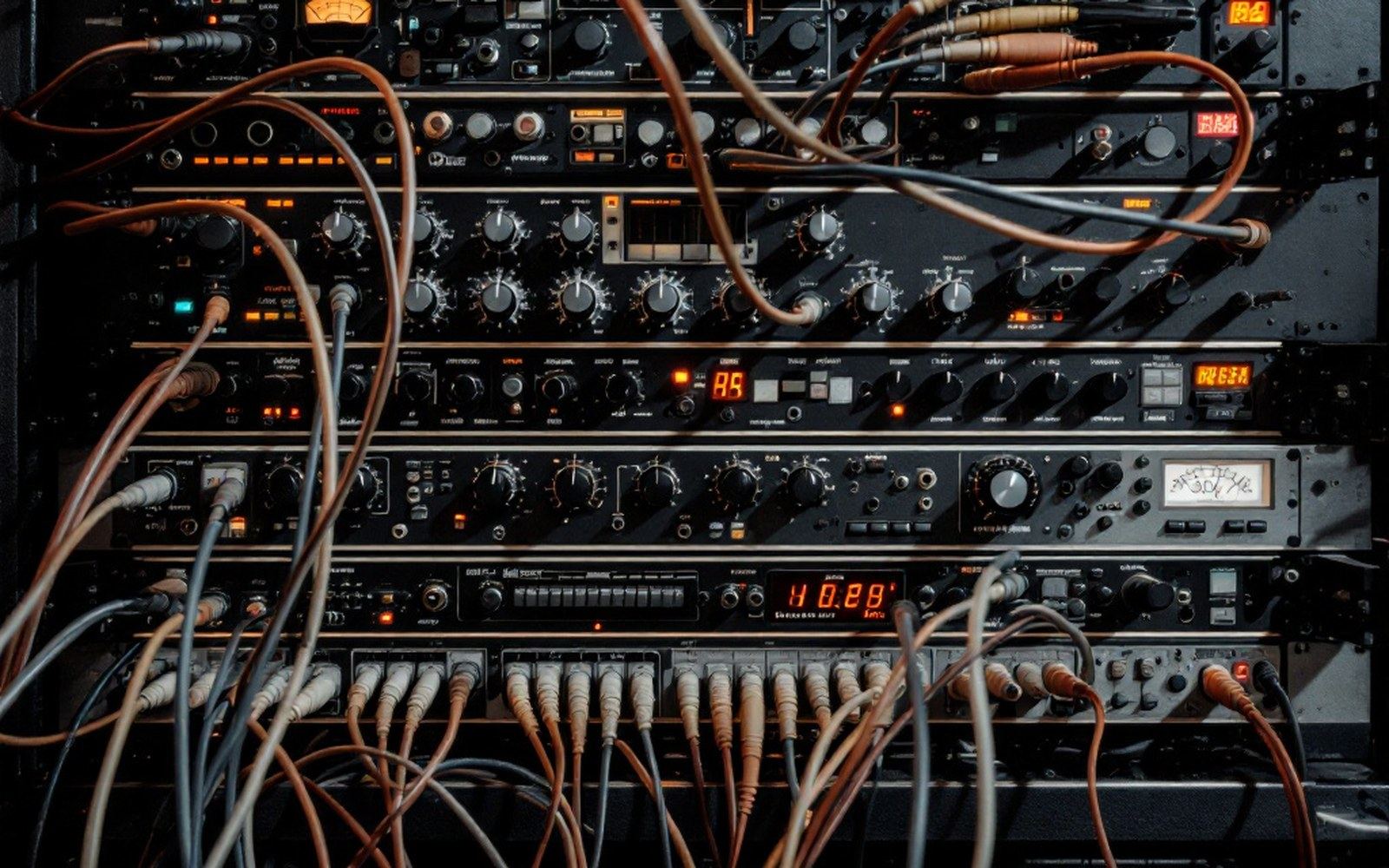
The guitars, where they remained prominent, were typically recorded clean or with minimal pedal treatment, then repositioned in the mix by level and by spatial processing. Chorus pedals appear in the documented rig lists of the period, adding a slight modulation that widened guitar parts in the stereo field without increasing their mid-frequency weight. The effect was to push the guitar further left and right — making it spatially present without making it sonically dominant. The centre stayed empty.
The room no one could book
What Hannett built across the Factory Records productions of 1979 to 1981 was, in effect, a signature acoustic environment — a virtual room that does not correspond to any physical space at Strawberry or Arrow or any other studio he used. It is a construction, assembled from delay times, reverb plates, level decisions and microphone positions. Producers who have tried to reverse-engineer it by booking the same rooms or sourcing the same hardware consistently report that the room is not in the equipment; it is in the decisions Hannett made about what to do with it.
The Hannett sound became, after the fact, one of the defining textures of post-punk — not because it was widely copied at the time, but because the records it produced were so widely heard. When darkwave producers in the mid-1980s reached for a sound that felt cold and spatially open, the lineage runs back to these specific choices: drums isolated, bass melodic, guitars thin at the centre, space left where the density should have been. The vocabulary was set by an engineer who understood that what you remove from a mix can be as definitive as what you leave in, and that the silence between instruments is itself a produced element — as deliberate, and as hard to fake, as anything captured on tape.
Key sessions and releases
| Record or room | Detail |
|---|---|
| Unknown Pleasures | Joy Division, FAC 10, Factory Records, 1979; produced by Martin Hannett at Strawberry Studios, Stockport |
| Closer | Joy Division, FACT 25, Factory Records, 1980; Hannett’s final full album with the band |
| Arrow Studios | Manchester — secondary recording location used for Factory sessions |
| Strawberry Studios | Stockport — primary studio for Hannett’s Factory work; also used by 10cc |
Table scrolls sideways →
Related pages